Category Archives: Technical Lake Stuff

[UPDATED] December 2021 Water Level Chart Archived

12 Clary-Lake-Water-Level-December-2021

December 2021

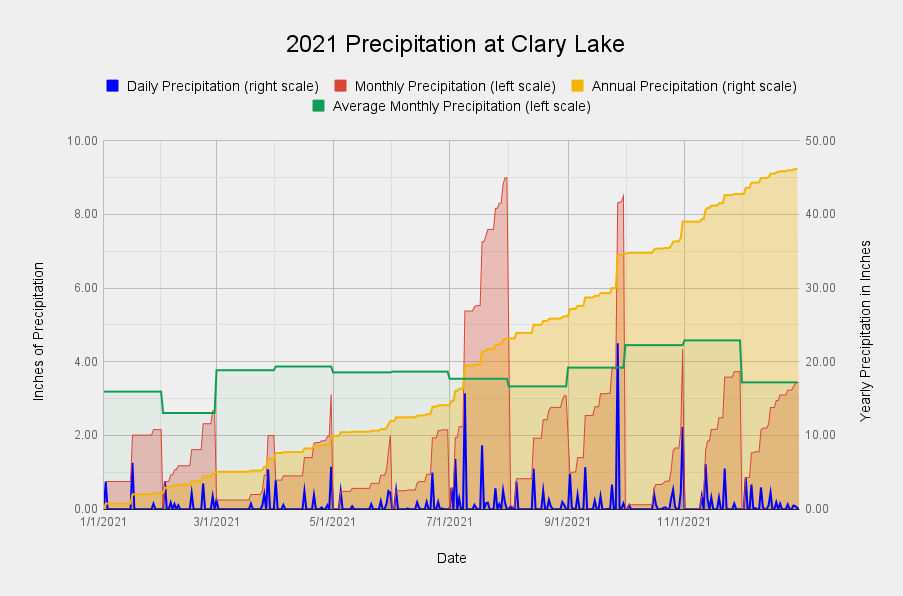
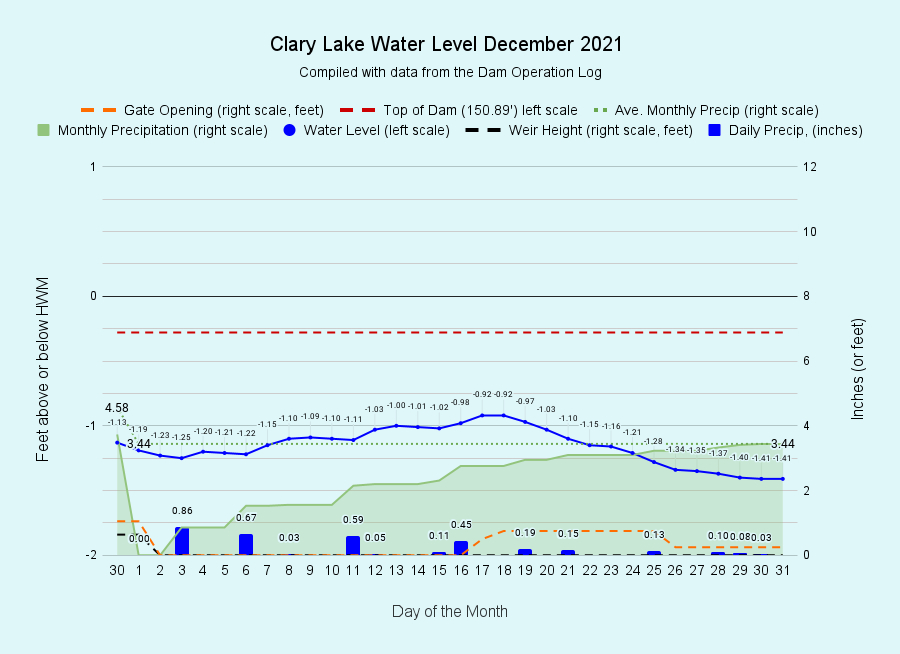
I have archived the December 2021 Water Level Chart (at left), bringing 2021 to a close. Our general goal in December is to get the lake down to about 18 inches by the time it freezes over, without overshooting the mark. We have after all only 24 inches to play with. As it turns out, the lake froze over on December 20th with the lake level down just 1 foot. Precipitation for the month was 3.44 inches, average for December, bringing us to 46.18 inches for the year, 2.12 inches more than average. It is only because of the excessive rainfall we received in July (9 inches) and September (8.5 inches) that we ended the year a bit ahead of average precipitation because for most of the rest of the year, we fell short of monthly averages. And that’s about all I’m going to say about December. It’s a New Year.
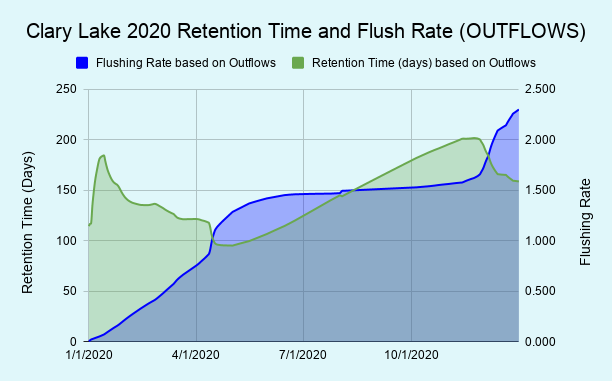
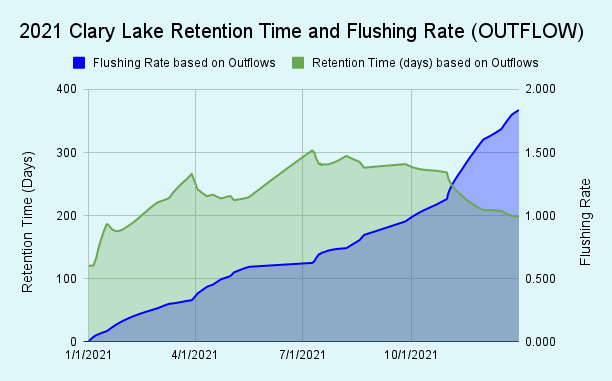
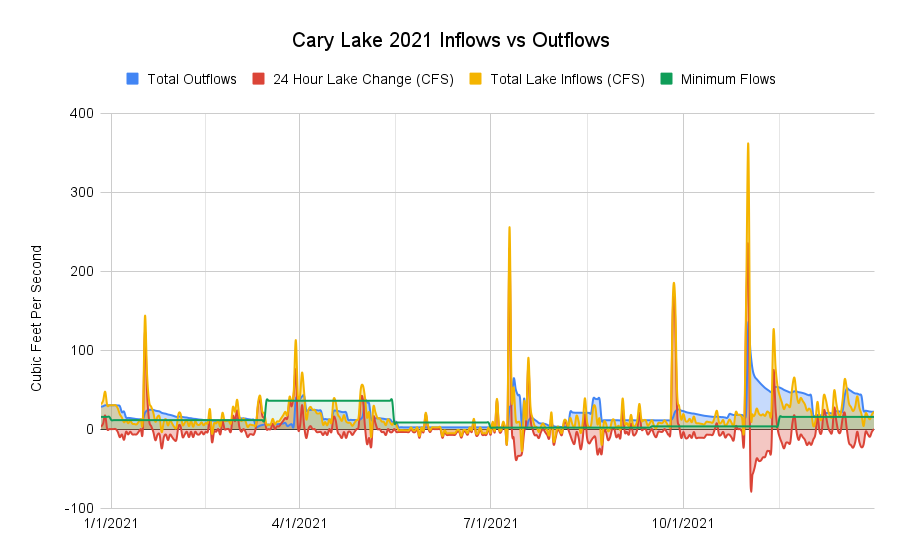
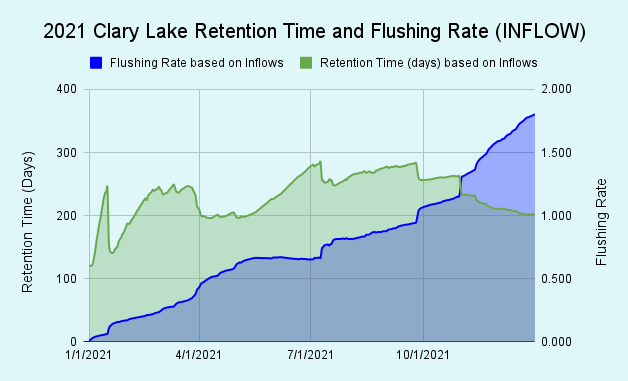
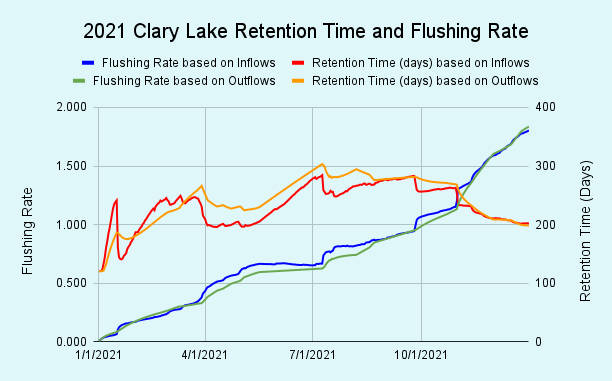
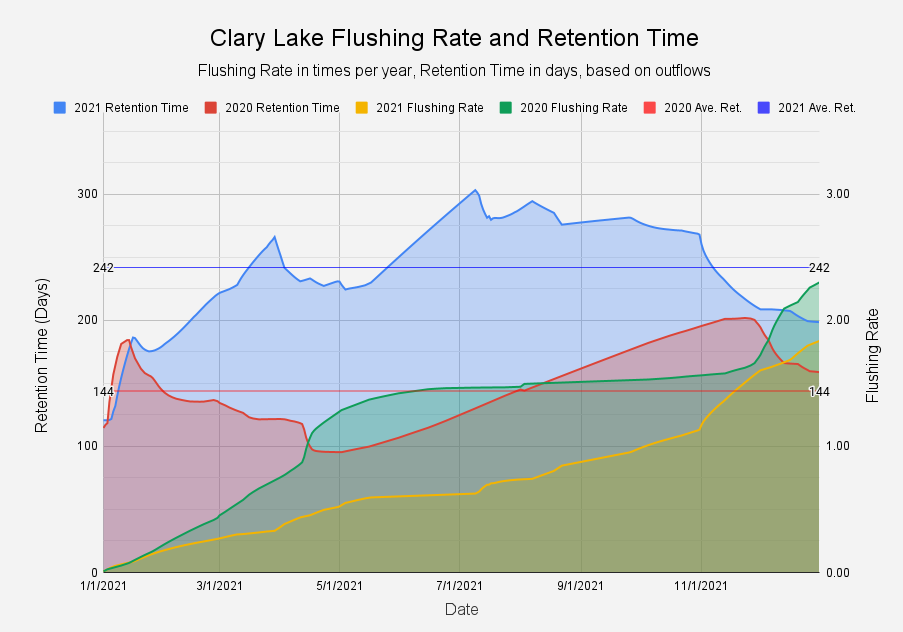
Clary-Lake-2020-Retention-Time-and-Flush-Rate-OUTFLOWS2021-Clary-Lake-Retention-Time-and-Flushing-Rate-OUTFLOWOne big difference between 2020 and 2021 turned out to be the flushing rates and retention times. In 2020 we had a flushing rate of about 2.3x with a retention time of 140 days. In 2021 the flushing rate was 1.8x (the same as the published rate for Clary Lake) with a retention time of 240 days. This is in effect a measure of the amount of water that passed through Clary Lake: in 2020, a total of 16,632 acre feet of water passed through the lake, in 2021 that figure was  significantly less, only 13,274 acre feet. The lower flushing rate in 2021 very likely had a beneficial effect on water quality.

[UPDATE]: I was so intrigued with the difference in flushing rate and retention time for 2020 and 2021 that I decided to graph them to make the differences more evident. Here’s the result:
I’ll add data for 2022 as it becomes available.

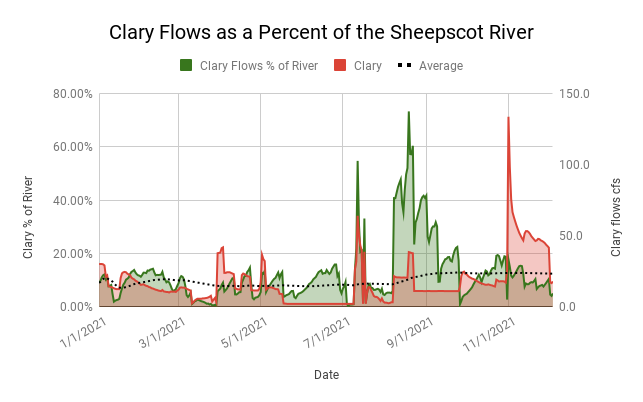
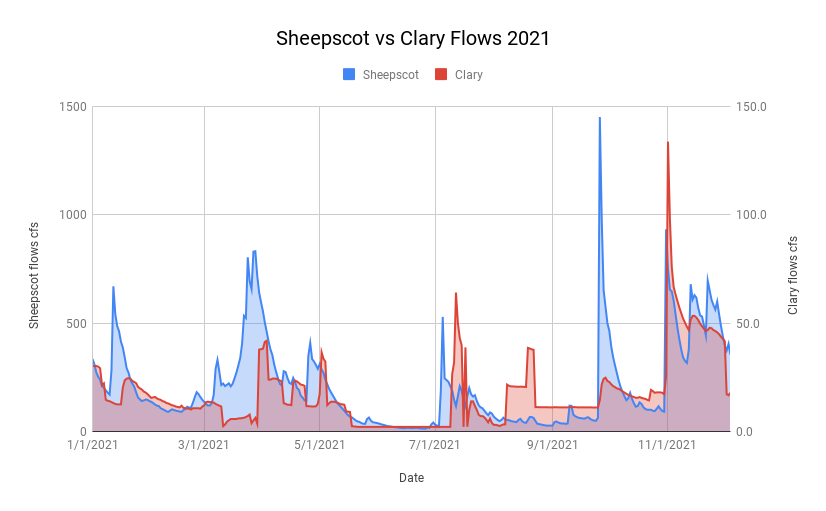
I can’t end 2021 without highlighting an interesting but ultimately useless bit of data analysis I wasted time on this year. Everyone knows that I love charts. If you don’t know that by now, then you simply haven’t been paying attention! I’d like to show you two fascinating but useless charts I made this year. First a bit of explanation. I have long thought it would be cool if I could somehow correlate the flows from Clary Lake with the flows in the Sheepscot River as measured at the Sheepscot River Gaging Station which is located at the foot of Grand Army Hill. It turns out you really can’t correlate the two flows in any reasonable fashion for two primary reasons. First, because the hydrological characteristics of the Clary Lake watershed (9.9 square miles) and that of the larger Sheepscot River watershed (142 square miles) are quite different. Clary should contribute 6.9% of the water measured at the gaging station but that figure actually varied from a low of around 1% to a high of 60% with an average of around 12.4%. Sheesh. Second, nobody actually controls the flows on the river, but we do in fact do control the outflows from Clary Lake so it is largely our own management activities that make correlating the two flows almost impossible. It would be nice if Clary outflows were always 6.9% of Sheepscot River flows, but I guess that would be too easy! Anyways, here are two charts I made while investigating whether a correlation between lake and river flows exists. One shows Clary Flows as a percentage of the Sheepscot River flows. The average turned out to be 12.43%. The other is a simple visual comparison of the two flow amounts which I did to see if anything jumped out at me. Nothing did:
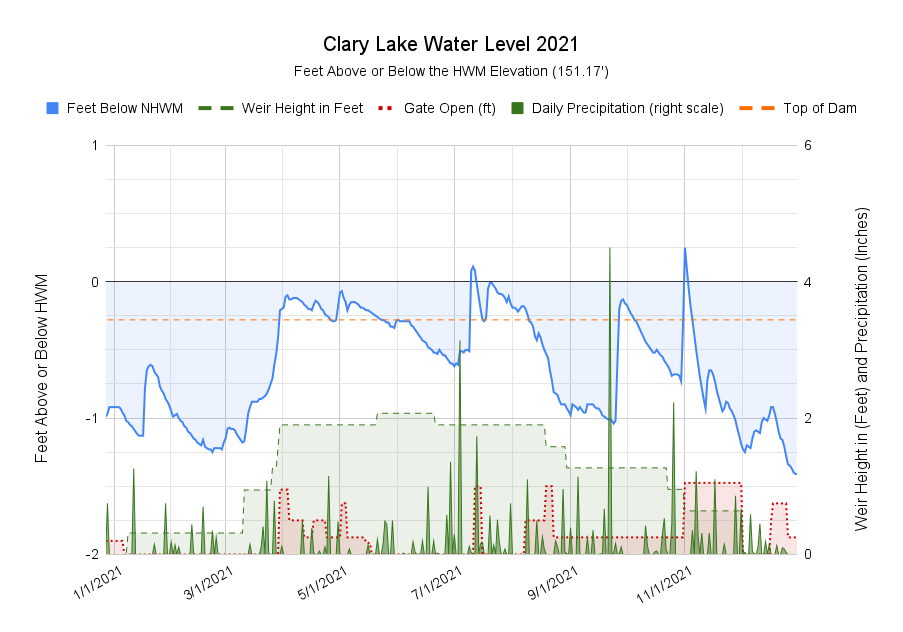
Here’s the 2021 Water Level Chart gallery:
Happy New Year everyone 🙂
20 December 2021: She’s Froze!

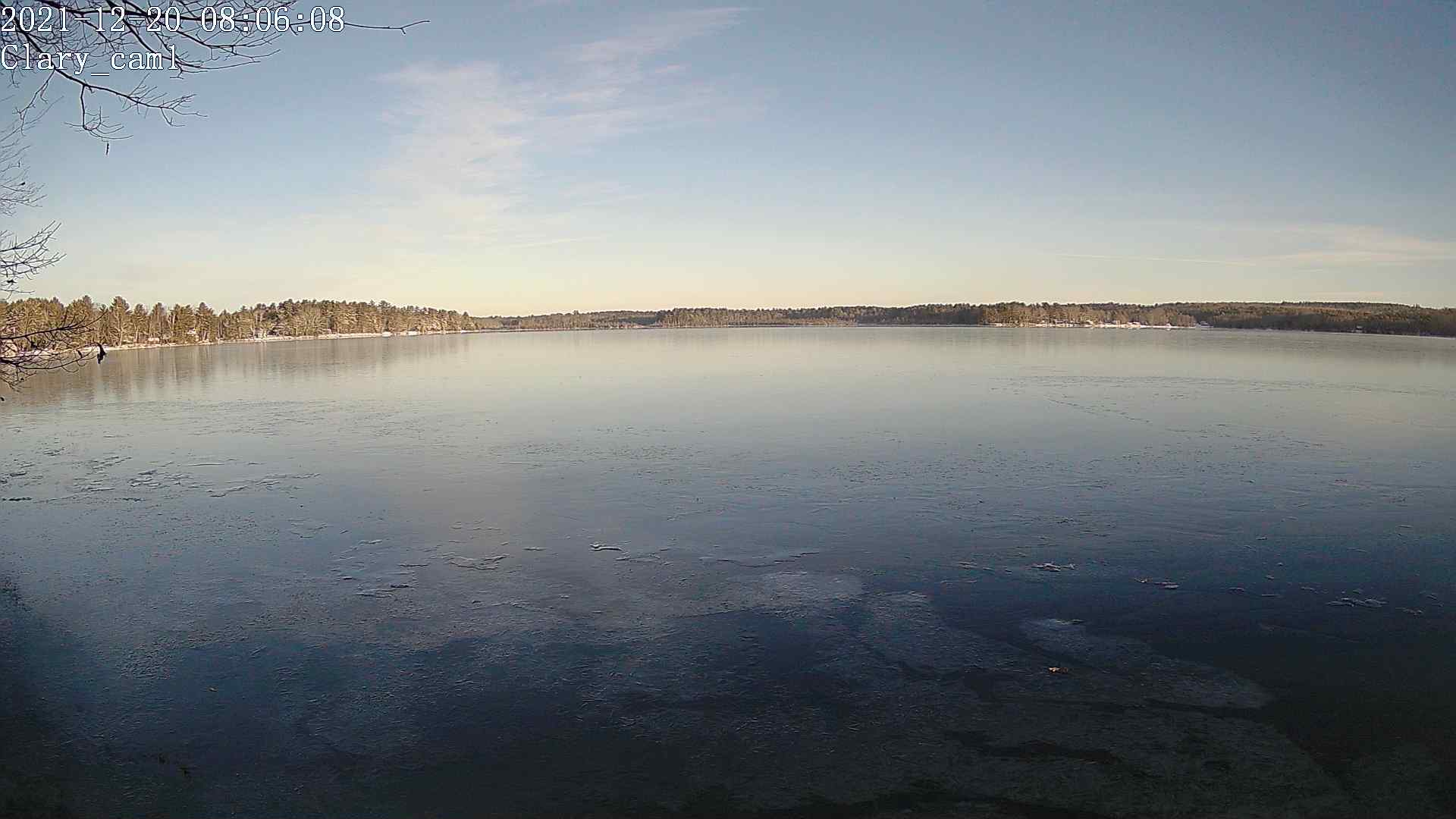
campic1-ice-in-12-20-2021Clary Lake has been trying to freeze over for about 3 weeks now, first at one end, then at the other. Each time it’s melted off. A good section out in front of my place has been ice free all along thanks to the ducks that come to our bird feeding station, they splash around and keep the ice from forming. Clary has just been waiting for a good cold night to freeze over, and last night was it. This morning the temperature was a paltry 9.9° F and from all appearances, the lake is now solidly frozen over. There is no sign of ducks today! Historically, A review of our Ice In and Ice Out Dates page shows that 12/20 is on the late side for the lake to freeze over. With the exception of the freak year in 2016 when the lake actually didn’t freeze over completely until January 15th, this is the latest ice-in date since the lake froze over on December 30, 2006. Continue reading

November 2021 Water Level Chart Archived

11 Clary-Lake-Water-Level-November-2021

November 2021

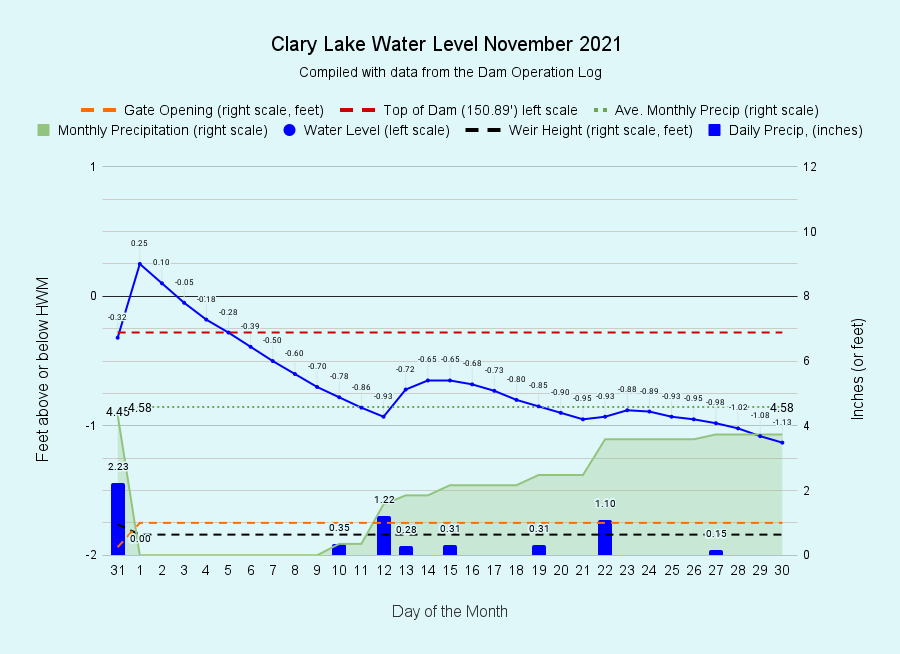
I have archived the November 2021 Water Level Chart (at left). The lake level in November was like a roller coaster ride. Our general plan for a dam operations in November is to get the lake level down a foot or so below the HWM in preparation for the lake freezing over sometime in December. A large rain event on the last day of October however brought the lake up to +0.25 ABOVE the high water mark, the highest the lake has been all year! On the first day of November we pulled one of the three remaining stop logs and opened the gate 1.05 feet to drain off some water which resulted in the lake level dropping 1.18 feet over over the next 12 days. Over the rest of the month we had numerous rain storms including one of 1.22 inches on the 12th and a 1.10 inch storm on the 22nd. This rainfall kept the lake level up higher than we would have liked. We ended the month with the lake level down 1.13 feet. Continue reading

October 2021 Water Level Chart Archived

10 Clary-Lake-Water-Level-October-2021

October 2021

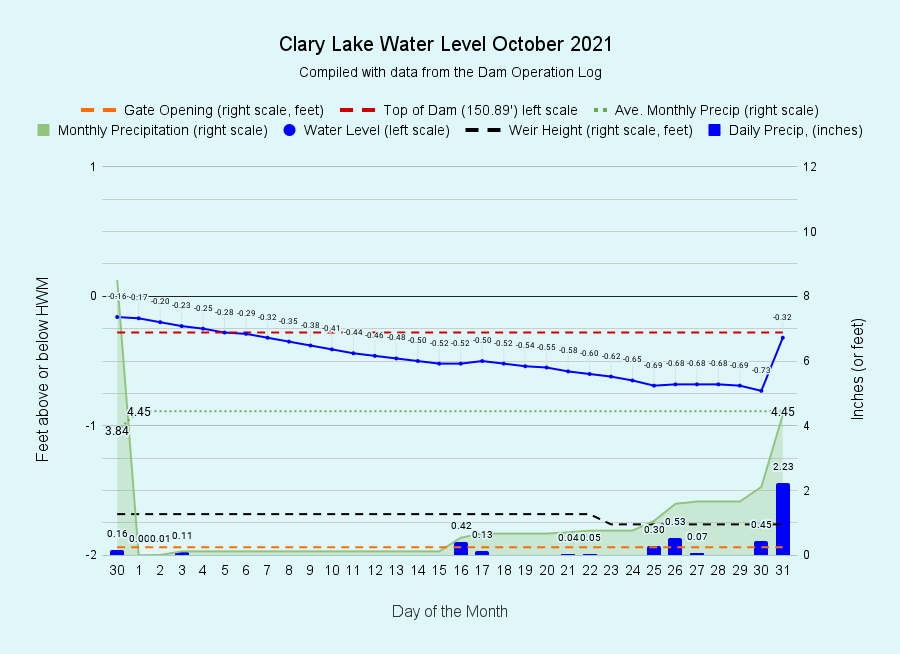
I have archived the October 2021 Water Level Chart (at left). October was looking to be a very dry month with rainfall well below normal until the next to the last day of the month when a significant wind and rain storm blew through the area. I recorded 2.68 inches of rain by the time the weather cleared on the 31st, bringing our monthly total to 4.34 inches, just shy of the average for October of 4.45 inches. There was a major 3 day northeaster back on the 25th of the month that was forecast to drop 3-5 inches of rain here, but it turned out to be mostly a southern Maine rain event; here we received less than an inch of rain. I thought we’d end the month with the lake level down around 1 foot below the top of the dam, but instead, by the end of the day on the 31st the there was water running OVER the top of the dam, with the lake level the highest it’s been all year. This morning as I’m writing this, the lake level is 0.25 above the High Water Mark, and still rising. Continue reading

Exploring Lake Phenomena: Langmuir Circulation

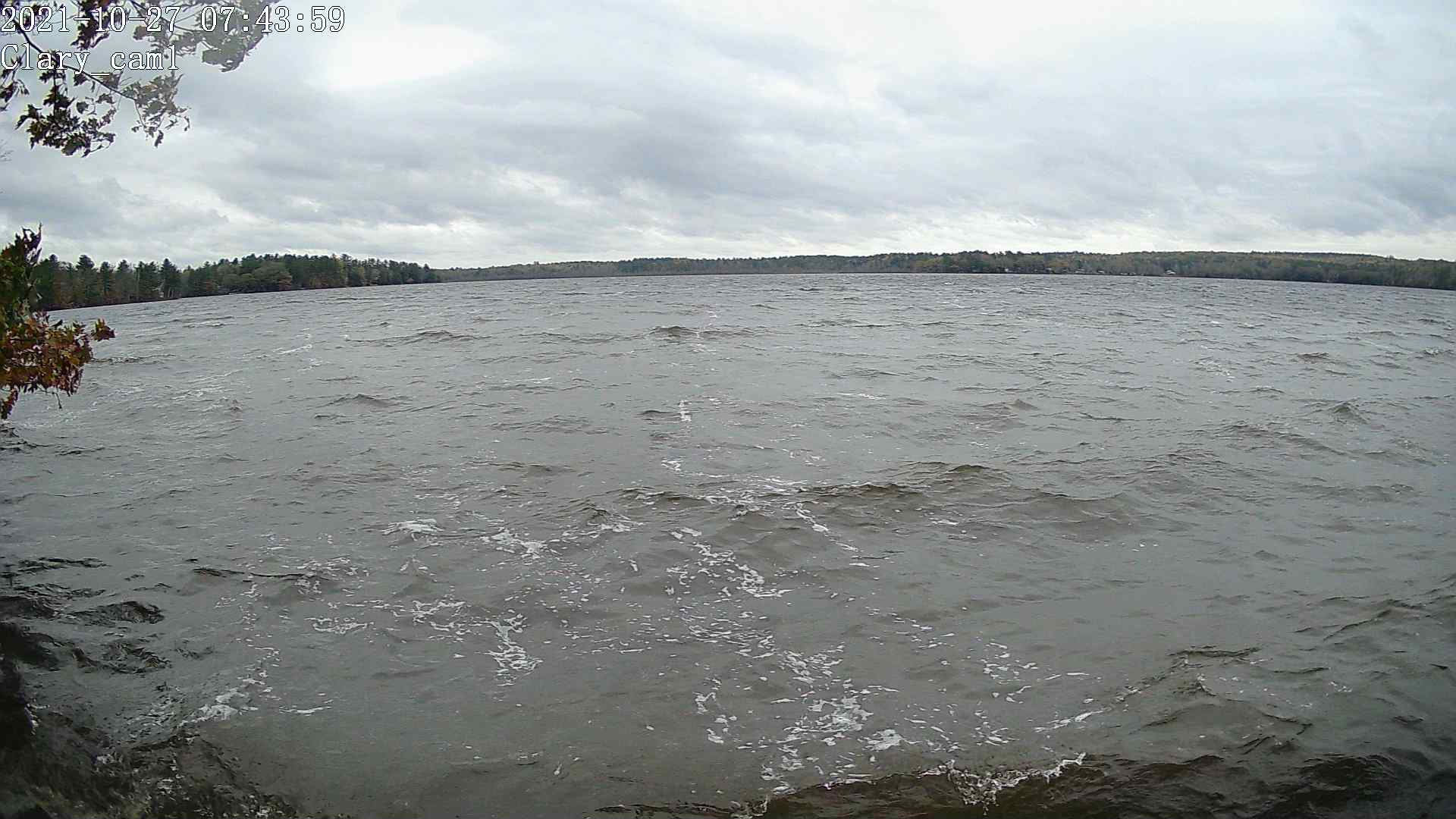
From time to time I like to highlight different lake phenomena, and today’s high winds and waves are a great opportunity to discuss Langmuir Circulation. The waves today are really stirring up the water, it’s brown and quite turbid and there are long lines of white froth on the water aligned with the wind direction. I’m sure you’ve seen this phenomena before. You can see those lines of froth in the webcam picture at left. Sitting here in my upstairs home office and looking out the window down at the lake, those lines of white froth are very evident. Continue reading

September 2021 Water Level Chart Archived

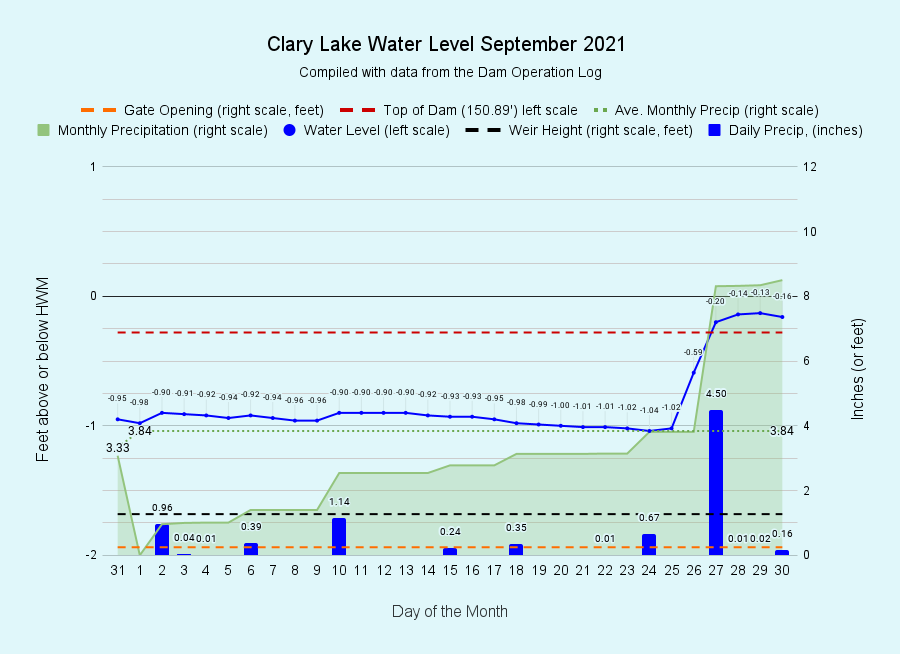
9 Clary-Lake-Water-Level-September-2021I have archived the September 2021 Water Level Chart (at left). September was on track for being an average, ho-hum kind of month with more or less normal rainfall (for a change!) and a stable unchanging water level until the 27th when we received a whopping 4.5 inches of rain in one storm. This sounds like a lot, and it was a lot, but it only brought the lake up 0.89 feet, from -1.02 feet below the HWM to just -0.13 feet below it. While this sounds like a lot, it’s actually a runoff multiplier of only 2.4X and considering how much rain we’ve had this summer, I expected the lake to have come up a lot more. By all rights we should have had water pouring over the full width of the dam but in fact we just had a wee bit dribbling over the top in a few spots. I won’t say I was disappointed, but I was surprised! The old rule of thumb is that an inch of rain should bring the lake up 4″ (a 4X multiplier) and if that rule had held true, the lake would have risen 18 inches instead of only 10 inches. For that matter, we’ve actually seen runoff multipliers considerably larger than 4X in the past. Continue reading

September 2021 Water Quality Update

Total Phosphorus Chart

Total Phosphorus Chart

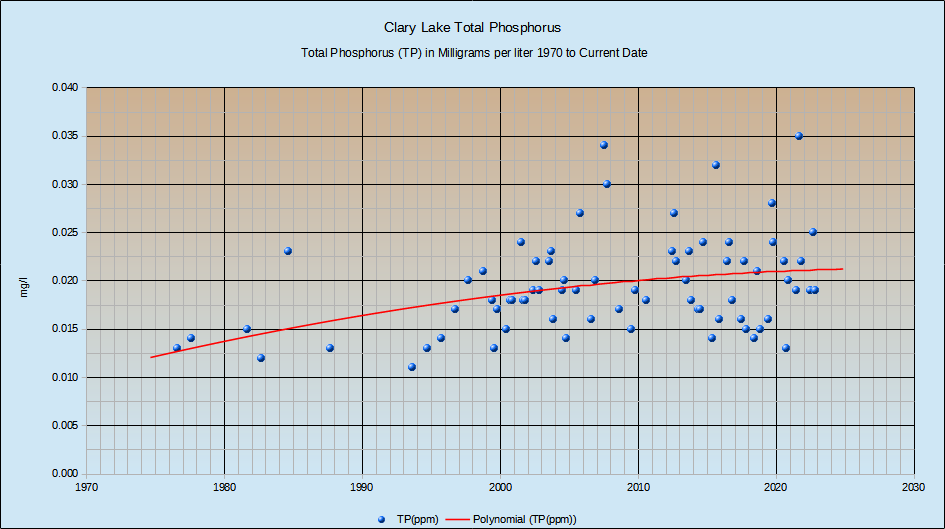
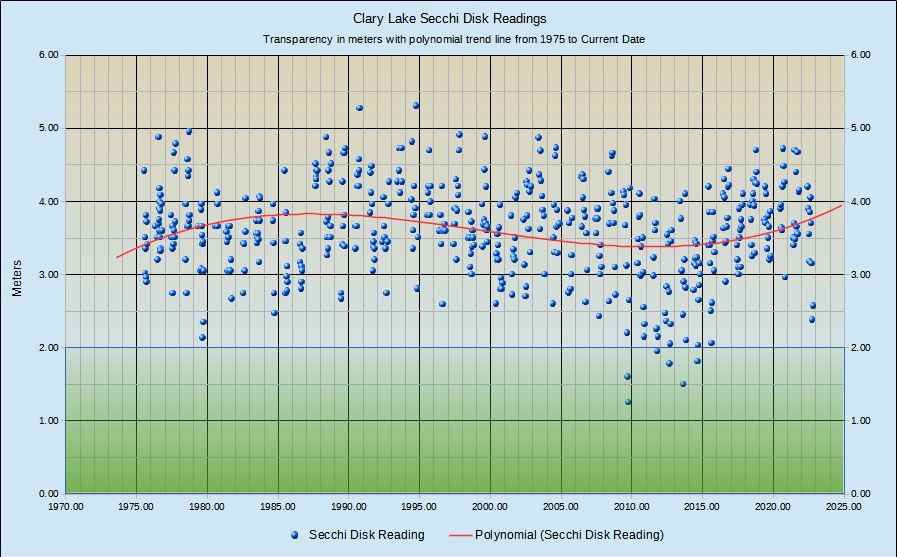
The Total Phosphorus test results from our 8/6/2021 core water sample came back the other day at 0.035 mg/liter, the highest TP value we’ve ever recorded. This is ominous. The next highest value we recorded was 0.034 mg/liter in July 2007 (see chart at left). I don’t remember the particular circumstances surrounding that reading, but there was another high TP reading of 0.032 mg/l more recently, in July 2015 that I do remember. It coincided with a secchi disk reading of only 1.95 meters indicating an algae bloom was in progress (secchi disk readings of 2 meters and below indicate a bloom in progress). You can see this 1.95 meter data point on the chart showing Clary transparency below. In this particular case, extreme low water conditions were a major contributing factor to poor water quality!! I expected a high TP value this time because of the 9″ of rain received in July. Rain means runoff and runoff means soil erosion and sedimentation which is the primary source of Phosphorus in lakes, but still, I was surprised to see such a high number. High phosphorus levels are not good for water quality! We really need to update our Watershed Survey!

Despite the high phosphorus level, we haven’t seen a significant algae bloom yet this summer and we may not, though I did notice a few wisps of dead cyanobacteria along the shoreline back in August, and water transparency is currently holding up nicely: at our last the water monitoring session on Sunday September 5th, Kelsie French and I had secchi disk readings of 3.55 and 3.45 meters respectively which is about average, and better than expected considering the level of phosphorus in the water. Transparency could deteriorate quickly however and we’re going to keep a close eye on it; we will take our 3rd and final water sample for Phosphorus testing during our next water quality monitoring session in a couple of weeks. Continue reading

August 2021 Water Level Chart Archived

8 Clary-Lake-Water-Level-August-2021

August 2021

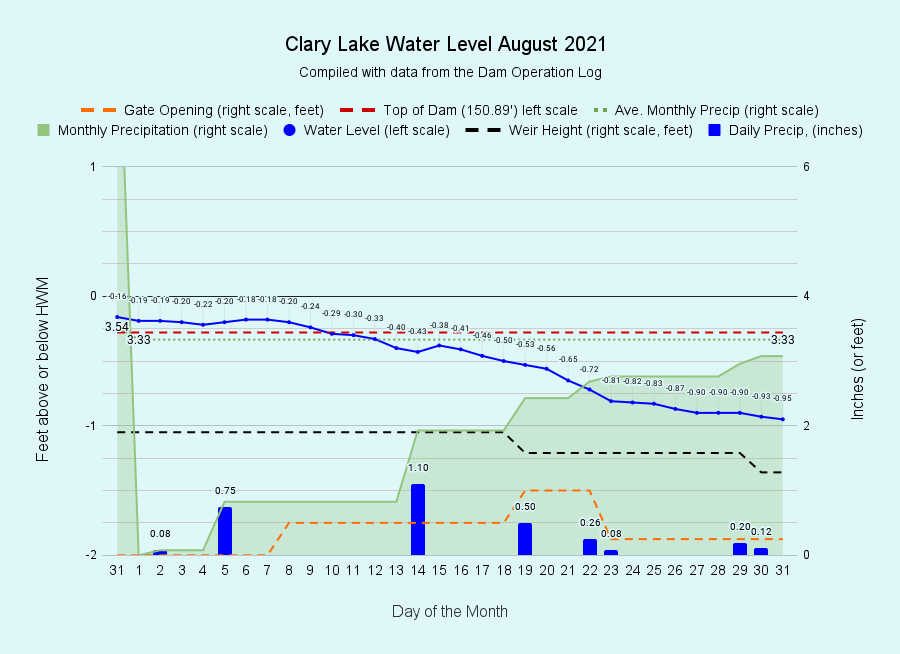
I have archived the August 2021 Water Level Chart (at left). The 3.08 inches of rain we received in August fell slightly short of the 3.33 inch average for the month, so we’re a little further behind (-1.58 inches) for the year than we were at the end of July. We’ve received 26.17 inches of rain to date, the average for the end of August is 27.75 inches. We also anticipated a good soaking as the remnants of Hurricane Fred and Hurricane Henri passed by within a few days of each other and on August 19th and we opened the dam’s gate a foot to release some water and create some headspace for what potentially could have been a lot of storm water runoff. The storms were a disappointment however, dropping only a combined total of 0.84 inches of rain with virtually no additional runoff and we ended up closing the gate 5 days after opening it, having lowered the lake a grand total of only 3.4 inches. Now it looks like Hurricane Ida which will be passing to our south later this week may result in significant rainfall. Time will tell. Continue reading

12 August 2021: Damariscotta Lake Blooms

Damariscotta Lake has been experiencing considerable cyanobacteria growth in recent years, a troubling condition that affects many lakes in Maine. Some lakes are big enough for these types of events to impact only certain areas, though they can be lake-wide. This particular algal bloom in Damariscotta is in the Mills area. So far this summer I’ve noticed only slightly elevated levels of blue-green algae (cyanobacteria) in Clary as evidenced by faint wisps of dead algae on the water surface and slightly reduced transparency in early August. This is most likely the result of runoff from heavy rains in July. A small amount of algae growth is  expected, and is more or less normal. Clary Lake however is by no means immune to severe algae blooms, defined as a transparency of 2 meters or less and while we haven’t experienced a severe bloom since 2014 (see chart at left), it can and will under the right condition happen again. It behooves us to be vigilant and minimize soil erosion on our properties to stop the introduction of sediment and phosphorus into our lake.

Algae Bloom at Damariscotta Mills Potentially Harmful

The Midcoast Conservancy staffer Patricia Nease who is monitoring the Damariscotta Lake bloom spoke at our recent Annual Meeting about the Invasive Plant Patrol program on Damariscotta Lake and things we should consider when starting up an IPP program on Clary Lake.

July 2021 Water Level Chart Archived

7 Clary-Lake-Water-Level-July-2021

July 2021

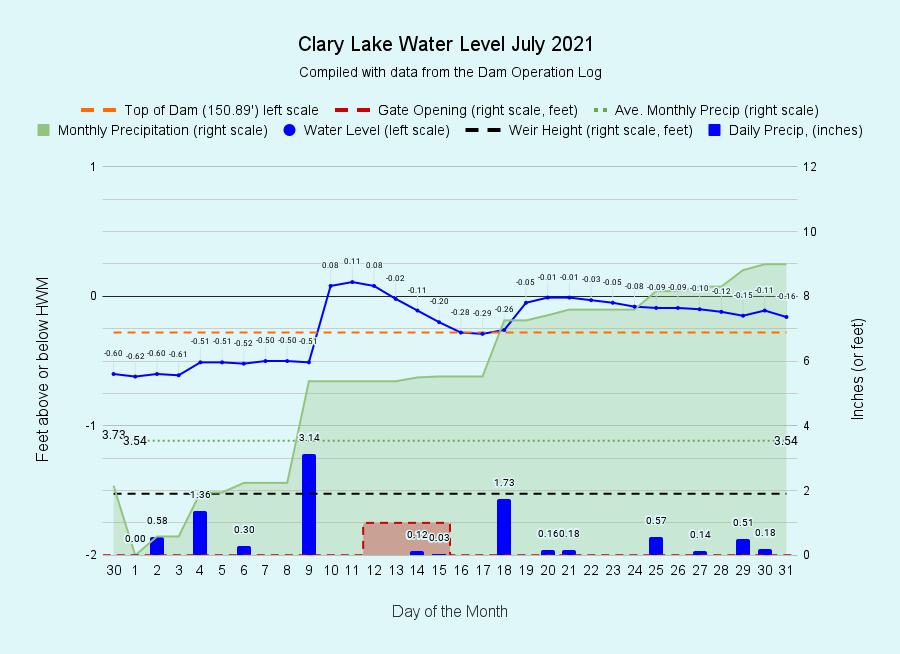
I have archived the July 2021 Water Level Chart (at left). And just like that, the drought was over. The dry conditions that have plagued us since the beginning of the year have been effectively wiped out in one month due to the exceptional amount of rainfall we received in July. At the beginning of the month we were 6.78 inches shy of rainfall for the year. Then over the course of the month we received a total of 9 inches of rain! As of the end of the month we’re shy only 1.33 inches of the average of 24.42 inches for this date. Of course, there’s no guarantee that the drought will stay gone, but at least for now we can relax. It does appear that mid-to-late summer and fall drought conditions are the new normal. Time will tell. Continue reading

10 July 2021: Hurricane Elsa Delivers Much Needed Rain [UPDATED]

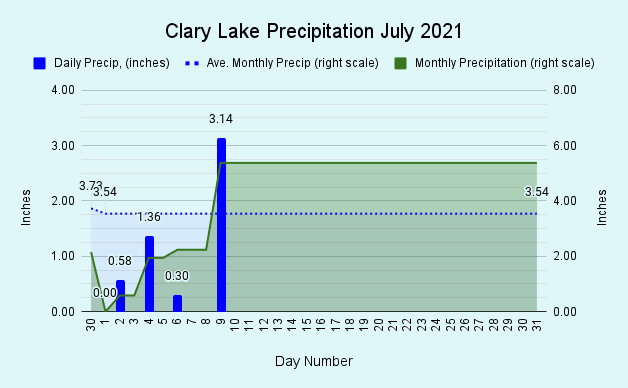
July 2021 Precipitation as of 7-10-21

On its way up the New England coast yesterday, Hurricane Elsa dropped over 3″ of rain on Clary Lake. While this won’t end our drought, it will go a long ways towards replenishing ground water supplies, and it brought the lake up enough for water to flow over the top of the dam again. For the month of July we’re now at 5.35 inches, well above  the average of 3.54 inches. For the year we’re now only (only?) 4.97 inches short of normal for this date.

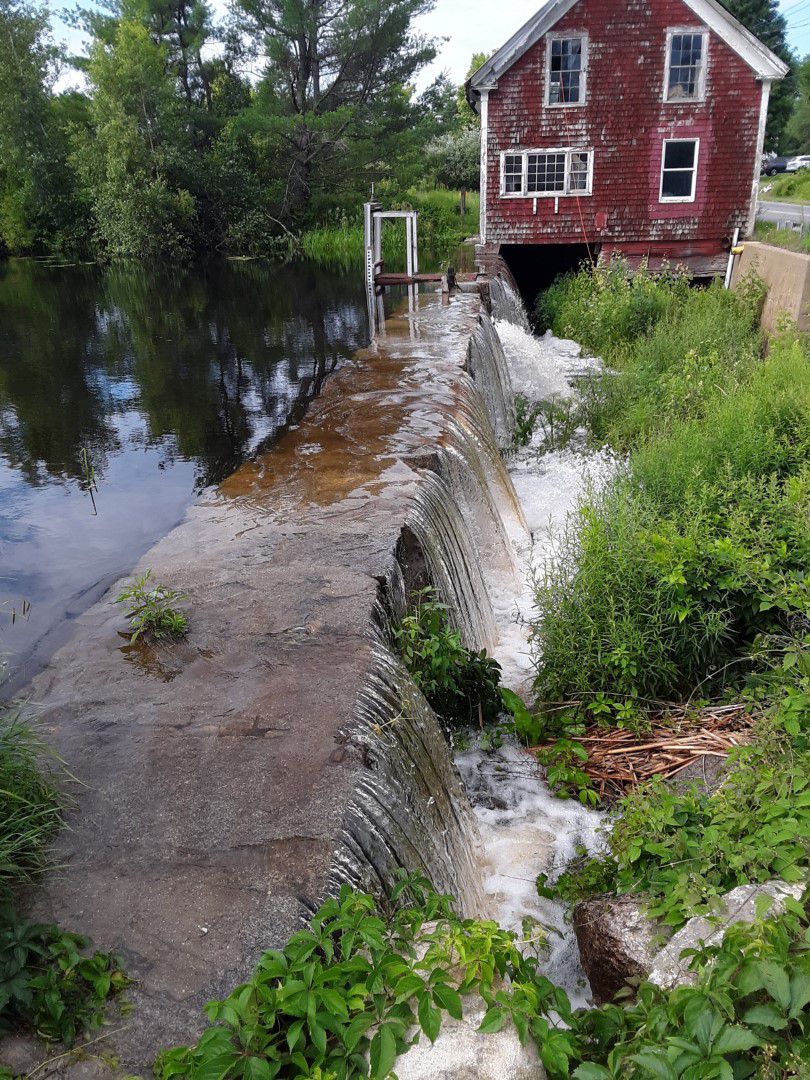
water-over-the-dam-7-10-2021_compressed[UPDATE]: As of this morning and for the FIRST TIME this year, the lake level is +0.08 feet ABOVE the High Water Mark having risen 7.08 inches since yesterday morning. Plenty of water flowing over the top of the dam as the picture at left shows. What a treat to have such high water this time of year!


June 2021 Water Level Chart Archived

6 Clary-Lake-Water-Level-June-2021

June 2021

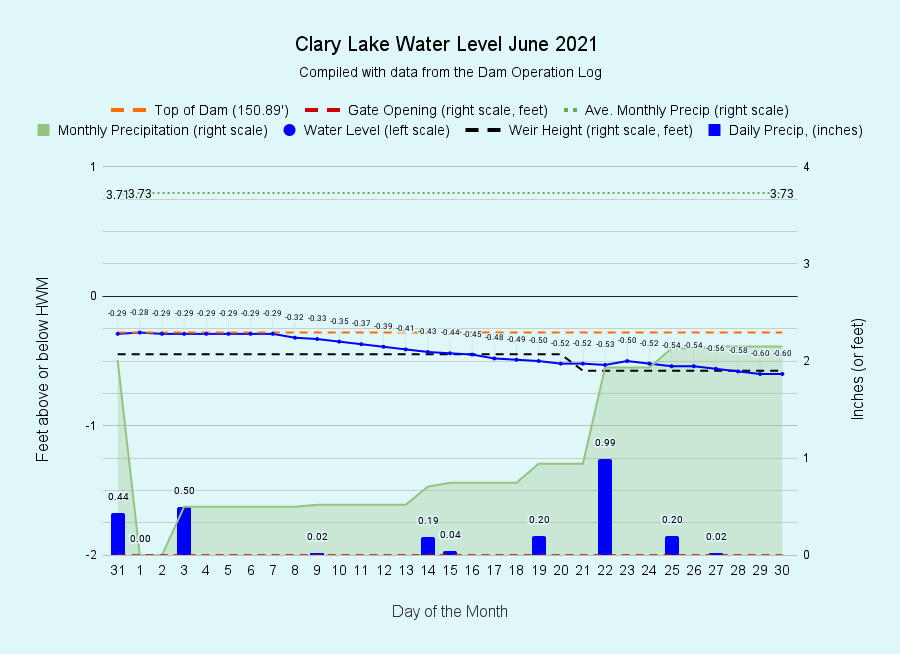
I have archived the June 2021 Water Level Chart (at left). The drought deepens. We were shy 5.20 inches of rainfall at the end of May, now we’re shy 6.76 inches of rainfall at  the end of June. We received a total of only 2.15 inches of rain in June, fully 1.58 inches less than normal. This brings us to 14.1 inches for the year to date. Our drought is nowhere near as severe as they’re experiencing in the western half of our country and especially in the southwest, but that is small consolation: this deficit will have a profound impact on our environment and ground water supplies for the rest of the year, and it’s not over. It’s so dry that even when we received a significant rainfall of 0.99 inches on the 22nd of June, the lake level only came up 1/3 of an inch. Lesser rainfall amounts during the month had almost no measurable effect on the lake level. There are two reasons for this: The primary explanation is that the ground around the lake is so dry that when the lake receives rain, the rising water is quickly wicked off into the surrounding dry shoreline. The other reason is that at this lake elevation, adding more water to the lake mostly makes the lake bigger, not deeper. Continue reading

May 2021 Water Level Chart Archived

5 Clary-Lake-Water-Level-May-2021

May 2021

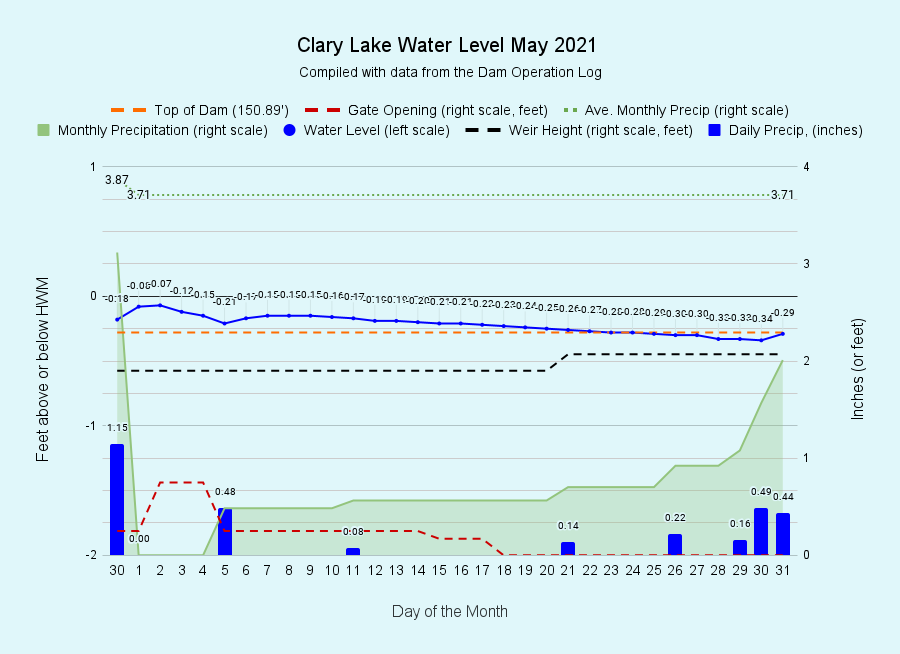
I have archived the May 2021 Water Level Chart (at left). The dearth of precipitation which has plagued us all winter continued through the month of May. At the end of April we were 3.50 inches short of normal for the year and today, on the last day of May, having received an underwhelming 1.91 inches for the month (normal for May is 3.71 inches), we’re now worse off at 5.20 inches short of where we would be in a normal year. It would have been even worse but for the 0.93 inches of rain we received on Memorial Day, the last day of the month. The timing was lousy but the rain itself was very much needed and I’m glad we got it. It also seemed like a fitting end to a long cold weekend that had me burning wood in my stove again; I’m OK with putting on a sweater in the house but I draw the line at wearing gloves at dinner! The three day weekend also marked the start of our Courtesy Boat Inspection program and unsurprisingly, we didn’t inspect any boats entering or leaving the lake. It was not the 3 day weekend you were looking for! Continue reading

02 May 2021: Water Quality Monitoring Resumes for 2021!

46 Years of Secchi Disk Measurements

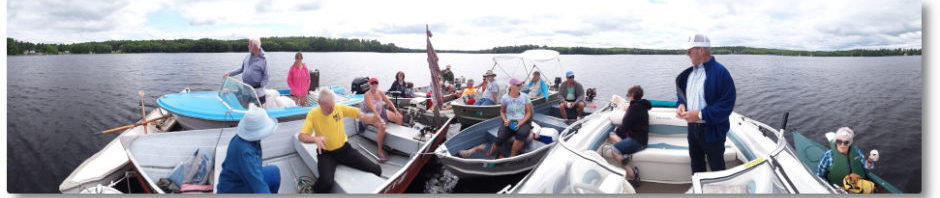
Kelsie French and I got out on the lake today to start Water Quality Monitoring for the 2021 season, a spring ritual that has been taking place on Clary Lake since 1975. All the data we collect is periodically sent to the Lake Stewards of Maine (formerly the Volunteer Lake Monitor Program) where it is checked for validity and accuracy. My father Stuart Fergusson was the first person to submit secchi disk readings for Clary Lake in 1975. David Hodsdon started accompanying him at about the same time and according to DEP’s Linda Bacon, David took over completely in 1991. For many years David worked solo until Jack Holland joined him around 2001. I got involved in 2013 and Kelsie French, our newest water quality monitor, started in 2018. After 44 years on the lake, David retired after completing the 2019 season and Jack Holland has taken a hiatus from water level monitoring. We hope he resumes sometime soon! Becoming a water quality monitor requires certification by the Lake Stewards of Maine, and periodic recertification. Continue reading

April Water Level Chart Archived

4 Clary-Lake-Water-Level-April-2021

April 2021

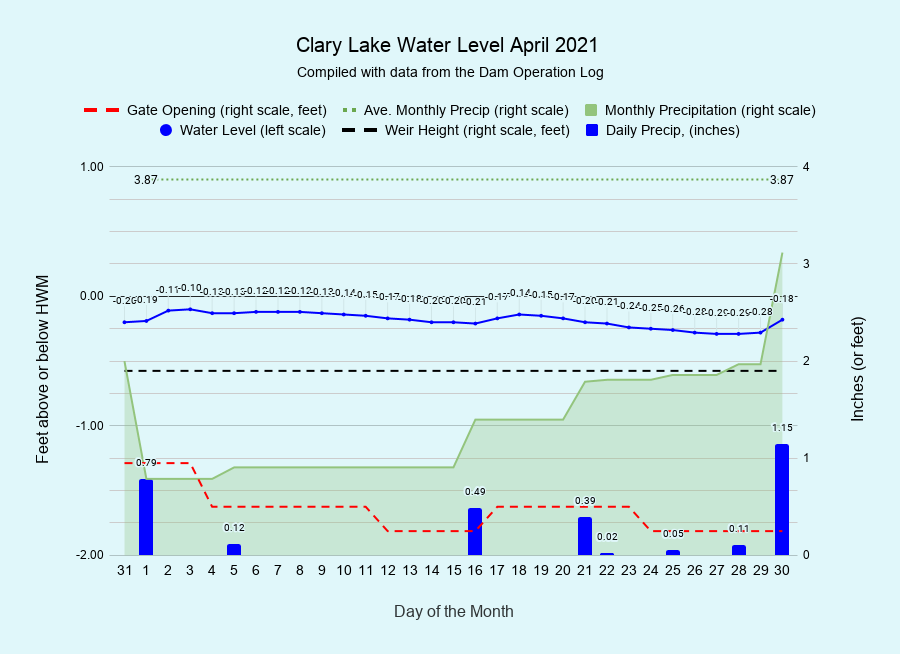
I have archived the April 2021 Water Level Chart (at left). The dearth of precipitation that has plagued us for much of last year and for the first three months of this year has continued into April with total monthly rainfall amounting to only 3.12 inches, a good deal of which we received on the last day of the month. This is well below the April average of 3.87 inches. Year to date we’re 3.5  inches below normal and we’re only a third of the way through the year. This does not bode well for ground water supplies this summer, even if precipitation returns to something like normal. The USDA has categorized this area of Maine as “Abnormally Dry” (see below) which is certainly an unusual condition for Springtime in the Northeast. Nationwide, drought conditions are much worse as this next graphic from the Maine Climate Office clearly shows: Continue reading

March 2021 Water Level Chart Archived

3 Clary-Lake-Water-Level-March-2021

March 2021

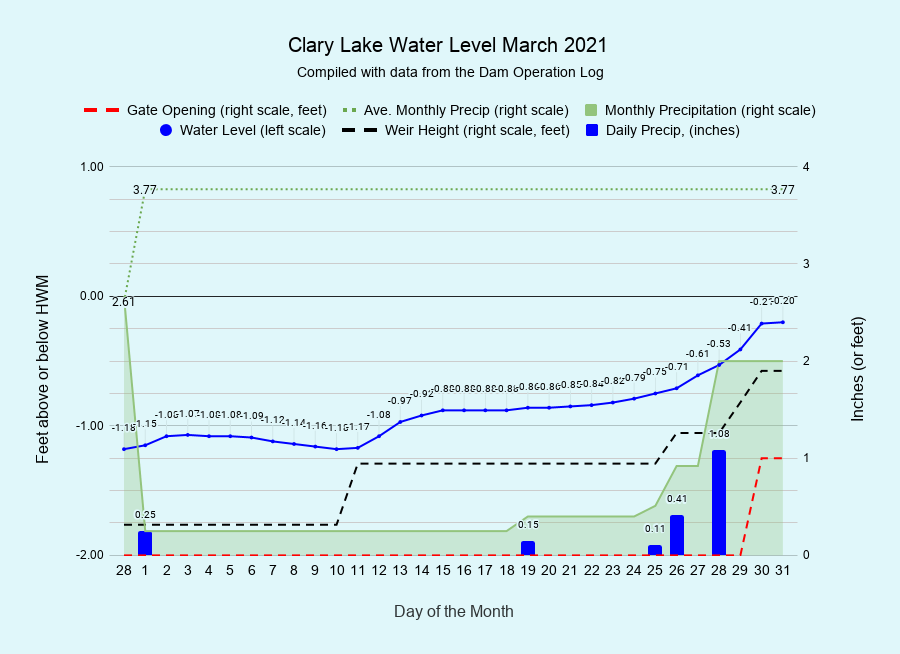
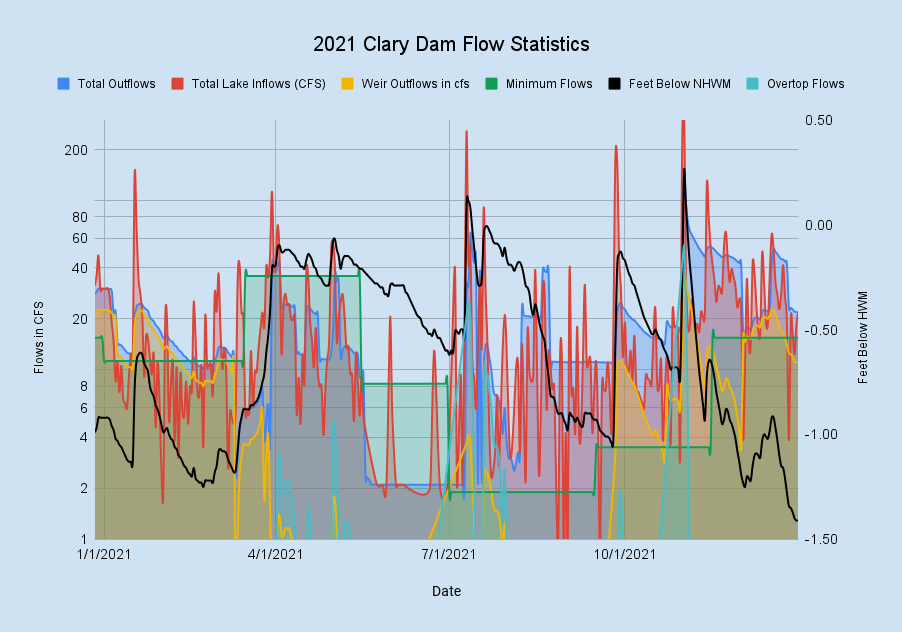
I have archived the March 2021 Water Level Chart (at left). Precipitation was again slow to accumulate in March and we ended the month with only 2.00 inches of rain, well below the monthly average of 3.77 inches. Despite the lack of snow pack and the lack of rain, we did succeed in filling the lake before the end of the month, and on pretty much the same date as last year. We did this by adding one or two stop logs, gradually raising the lake level (the black dashed line on the chart represents the height of stop logs in the weir). The dam’s gate was closed for the entire month and was only opened 1 foot on the 30th in anticipation of a significant rain event on expected on April 1st, no fooling! Filling the lake in the spring is made easier when there is more water to work with; we were able to do it this spring largely at the expense of meeting the minimum flow requirement. We started the month with the lake level down -1.15 feet below the HWM and ended up on March 31st with the lake at -0.20 feet below the HWM with a little water running over the dam. The ice went out on March 29th. Continue reading

February 2021 Water Level Chart Archived

2 Clary-Lake-Water-Level-February-2021

February 2021

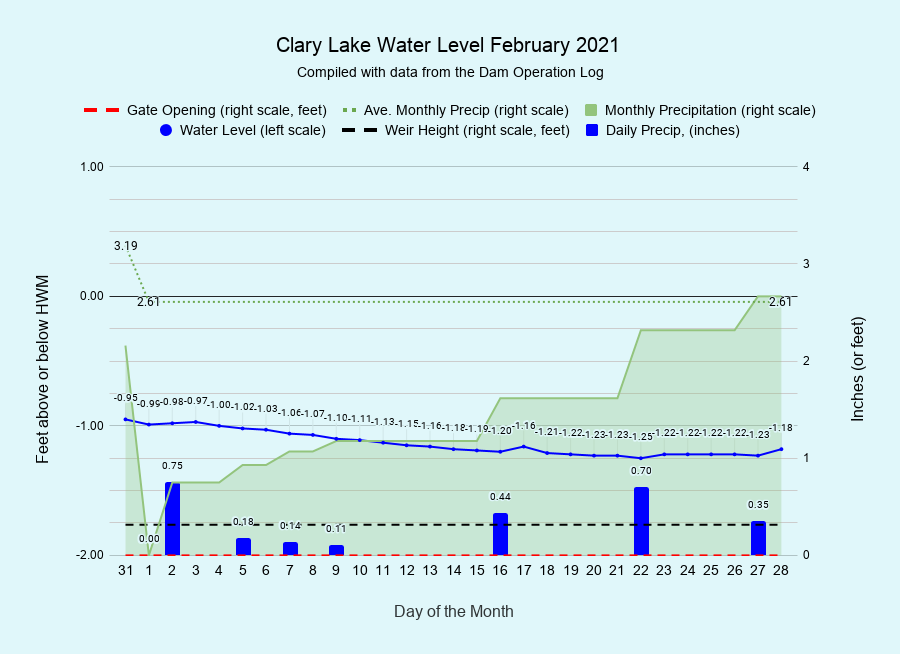
I have archived the February 2021 Water Level Chart (at left). Precipitation was slow to accumulate this month but a rain/snow storm on the 27th finally pushed us to 2.67 inches for the month, just a hair above the February average of 2.61 inches. Year to date however we’re still the better part of an inch below normal and without any snow pack to speak of, we are looking at a drier than usual Spring. Most of Maine is not in drought this winter but there are some areas on the coast not far south from here that are considered “abnormally dry.” A lot can (and probably will) change between now and April. Continue reading

January 2021 Water Level Chart Archived

1 Clary-Lake-Water-Level-January-2021

January 2021

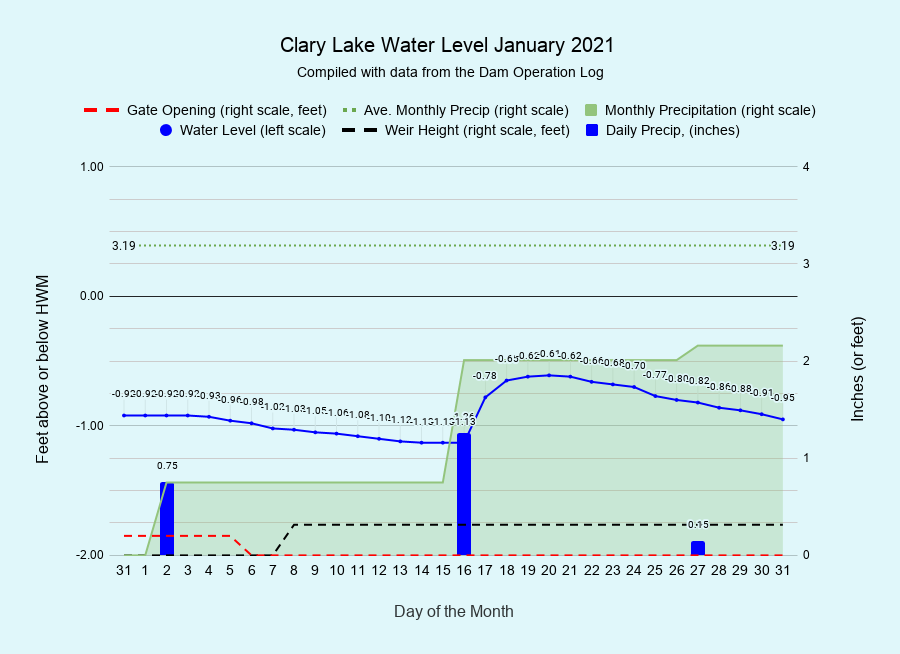
I have archived the January 2021 Water Level Chart (at left). The drought conditions that plagued us last year have returned early in 2021 with January’s precipitation of 2.16 inches falling considerably short of the normal monthly precipitation of 3.19 inches. February is the month with typically the lowest (2.61 inches) monthly precipitation of the year. We’re going to start February with a decent shot of snow in a couple of days. Hopefully we’ll develop a good snow pack by spring. Continue reading

Lake Stewards of Maine 2021 Winter Newsletter Is Out

Lake Stewards of Maine (formerly Maine Volunteer Water Monitoring Program) has mailed their Winter 2021 newsletter, The Water Column. Print copies are in the mail and should arrive any day. As usual, they’ve produced a great publication. I especially liked the articles on “Influences of Extreme Weather on Maine Lakes in 2020” (on page 16) and Late Season Algae “Flash Blooms” in Lakes” (on page 26), both by LSM Executive Director Scott Williams. Also, the article “Changes to Communication & Technology in
the Past Few Years and the Spurs of CoViD-19″ by Tristan Taber was quite interesting. Continue reading

December 2020 Water Level Chart Archived

12 Clary-Lake-Water-Level-December-2020

December 2020

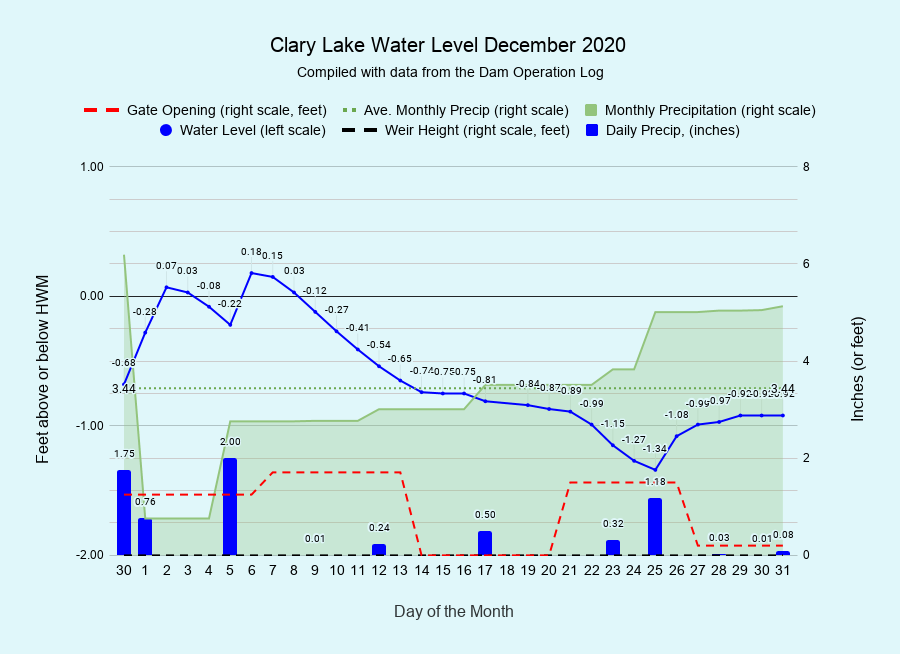
And so we arrive at the end of another year. I have archived the December 2020 Water Level Chart (at left) and much like 2020 was a roller coaster year, December was a roller coaster month in terms of rainfall and resulting water level fluctuations! On the last day of November we received 1.75 inches of rain followed by 0.76 inches more the next day. This pushed the lake level from 0.68 feet below the HWM to 0.07 feet above the HWM almost overnight, resulting in water flowing over the top of the dam for the first time since last spring. Then on December 5th we received 2.00 inches of rain which drove the lake level even higher, to 0.18 feet above the HWM, despite our efforts to mitigate the lake level rise. From there the lake fell more or less steadily to the month low of 1.34 feet below the HWM. More rain on the 23rd and 25th of the month again pushed the lake level up to a little less than 1 foot below the HWM. It would have gone a lot higher if we hadn’t opened the gate to drain off more water in anticipation of the additional rainfall. The heavy rains, warm temperatures, and high winds on Christmas day resulted in most of the lake’s ice melting off. The lake completely froze over for the first time on December 19th. At the time of this writing, most of the lake remains ice free. Continue reading